

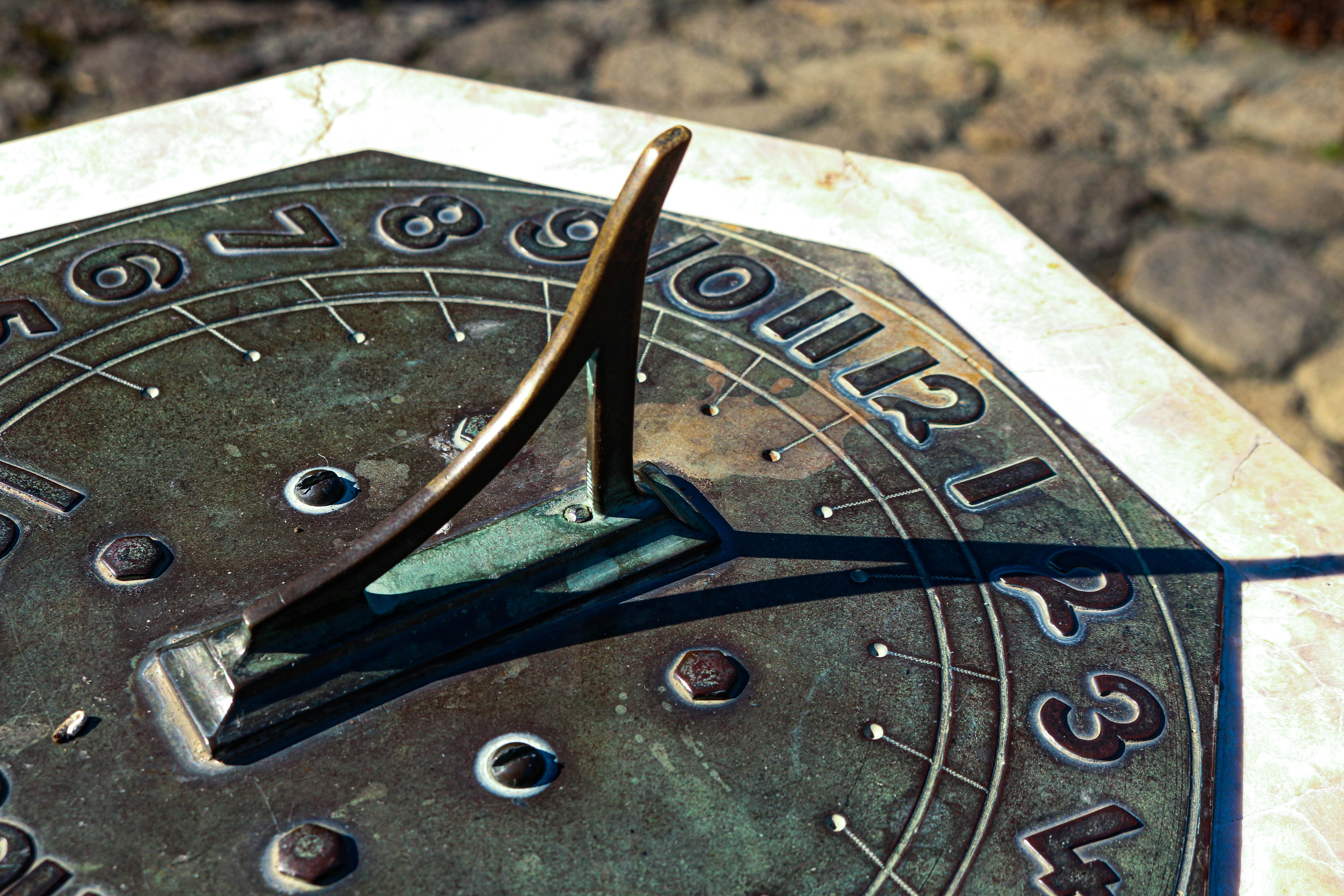
Photo by Mark Vihtelic on Unsplash
I recently learned the word kairos.
It’s an ancient Greek concept that translates loosely to the right moment. Not clock time. Not deadlines or duration. Something else entirely.
The Greeks contrasted kairos with chronos.
Chronos is quantitative. It's the time we schedule. The calendar, the clock, the appointment, and the meeting invite. The tidy ticking forward that modern life is built upon, and treats it as neutral, objective, and inevitable. As normal.
The other side of that coin: Kairos is qualitative. It describes the moment when conditions align. When something can actually land. When an action, a truth, or a relationship becomes possible, not because enough time has passed, but because the field is ready. There’s an inherent openness to it.
Once I encountered this distinction, something in me came alive and settled at the same moment. Because I realized I have been naturally suited to kairos my entire life. And learning to survive by overriding it in a chronos world.
My body has never experienced time as linear progression.
Meaning doesn’t arrive for me incrementally. It forms through long periods of silent accumulation, organization, layering, sensing, and return. Before meaning is complete and settled, speaking feels premature. Acting feels dishonest. There is a felt constraint in my body, as if I’m being held still by my own ethics. But once complete meaning has settled, movement feels almost inevitable. Clean. Obvious.
When observed from the outside, especially by someone who doesn’t know or understand me well, this can look like hesitation or delay. Or as being difficult. Refusal. But what I experience on the inside is constantly updating attunement. I’m sensing for readiness. For coherence. For whether the moment has actually opened.
This isn't something I decide to do. It happens automatically. Readiness registers in my body and cognition before I have language for it. I can override it, and for years I did, but I can't train it out or swap it for clock time. Kairos isn't a preference for me. It's how timing is perceived.
This orientation has shaped everything. Especially my relationships.
Before I go further, I want to clarify something about how I experience relationships.
I don’t claim to read situations perfectly. I misjudge timing. I reach when I shouldn’t. I test closeness and sometimes discover I was wrong about what was possible.
What’s been consistent isn’t accuracy. It’s response.
I’ve learned to approach gently. To test the space. I read behavioral signals—body language, tone shifts, energy changes—in higher fidelity than spoken words. When someone says “it’s fine” but their body says something different, I notice the gap. And I hesitate. Are you sure? That’s not what I’m reading.
When that signal mismatch appears, or when a clear stop sign comes through any channel, I stop.
That responsiveness isn’t strategy or restraint. It’s how I stay oriented to the field.
One of the first places I see this clearly now is in my relationship with my father.
Attunement was not a stable baseline there. What existed instead was a child’s sensitivity inside a field that was repeatedly betrayed.
During my parents’ divorce, my father’s infidelity, drinking, suicidality, and volatility shattered whatever relational safety might have existed before. The emotional field became unpredictable and unsafe. Trust didn’t erode gradually. It collapsed. And once a field is broken that completely, it cannot be entered without cost.
In that context, closeness didn’t simply fail to arrive. It became structurally impossible. Any opening flickered briefly, then closed. I learned to approach carefully, to test the space, and to stop when the field signaled danger or withdrawal.
For a long time, I interpreted that as distance. Or restraint. Or something I failed to push past.
Through a kairos lens, I see it differently now.
What I was responding to wasn’t ambiguity. It was absence of receptivity caused by rupture. The conditions for mutuality were not present, and no amount of effort could create them.
At a certain point, I took a long pause from the relationship. Years. Not as punishment, and not as indifference, but because the field needed distance before it could be rebuilt at all.
When we reconnected later, what stands out to me now is how consistently kairos governed what followed. We were in contact regularly, but closeness never fully opened. Not because I didn’t want it. Not because I didn’t try. But because the moment never stabilized into something that could hold it. And there wasn’t enough signal clarity for me to trust it fully.
And then, near the end of his life, something shifted.
As the window of his life was closing, the field opened briefly. Not fully, and not without sorrow, but enough. Enough to see that this wasn’t about avoidance or failure. It was about what becomes possible only when nothing more can be deferred or forced.
That opening didn’t erase what came before. But it made everything clearer.
The grief I carry isn’t the grief of “I didn’t try hard enough.” It’s the grief of “the field could only open when there was almost no time left.”
I see the same pattern later in my life, this time in a professional relationship that cost me dearly. It had emerged from a long-term core friendship.
I tried, repeatedly, to offer clarity, care, truth, and leadership. Each time, I checked for receptivity. Sometimes I misjudged at first. Sometimes the signals looked promising. Praise. Reliance. Language that implied trust.
But words have never been the primary signal for me. They’re a conduit, not the substance. I experience time less as a sequence of moments and more as a field. Meaning gathers across interactions, actions, pauses, and returns. What matters isn’t what is said in a single moment, but whether the pattern holds over time.
There’s language for this that I didn’t have for most of my life. Some people call it chronodiversity: the reality that humans genuinely organize time differently. I’ve also encountered the terms everywhen and meaning-time, terms I learned from Jaime Hoerricks, PhD*, which both name the experience of sensing coherence across time rather than at a single point within it. These descriptions landed immediately, because they matched what my body already knew.
That’s where the mismatch registered.
Receptivity isn’t verbal. It’s structural. It shows up as changed behavior, shared reality, follow-through. Openness. When words and actions diverge, my nervous system doesn’t debate. It forces a recalibration through clarity seeking. And when that clarity is blocked, my nervous system locks. The same felt constraint that keeps me from acting before a moment is ready also alerts me when something being offered isn’t coherent.
I was reading operational and financial reality accurately. Thirty years of experience, embedded in the daily work, holding the systems together. The data was clear. The patterns were clear.
She was operating from aspirational reality rather than operational reality. I kept trying to translate. To show her what I was seeing. To request help, scope reduction, coherence. Anything that might bridge the gap.
She didn’t engage with those requests. Whether she couldn’t or wouldn’t, the pattern was consistent: words that sounded like resolution, no change in reality.
I knew this. My system was signaling it clearly.
And I kept trying anyway.
Not because I misread the field. Because I loved her. Because I had what she needed. Because I was holding everything together and believed that if I could just translate it well enough, the moment might finally open.
That’s where I violated my own timing. Not in failing to see. In continuing to act past the point where my own signals were telling me to stop.
From a chronos perspective, this can look like dedication or perseverance. From a kairos perspective, it’s override. You don’t keep offering clarity into a field that can’t receive it just to prove endurance.
What I understand now is that I wasn’t failing to lead. I was responding to reality as it actually was, and then choosing to stay anyway, at cost to myself.
There’s an important distinction I need to make here.
In personal relationships, I always respect kairos. When receptivity isn’t present, I don’t push. I don’t escalate. I don’t force closeness, understanding, or repair past a clear stop sign. When the moment closes, I stop.
That isn’t withdrawal. It’s an ethic.
In professional contexts, I’ve learned to override my own timing when necessary. To speak before coherence fully arrives. To act before complete readiness. To function inside incoherence when survival requires it.
But when a professional environment confirms over time that it’s structurally incoherent, that the mismatch can’t be corrected, I leave. I recognize it can’t be fixed and I find the exit.
What broke me in this situation was that the relationship lived in both categories simultaneously. The friendship kept me there past the point where professional pattern recognition would have moved me toward the door. I couldn’t force coherence (personal ethic). I couldn’t leave the incoherence (friendship anchor). The override became sustained rather than temporary. The signal became impossible to resolve. Honoring one system meant violating the other.
I didn’t violate her boundaries. I violated my own. For years.
In most professional contexts, the override is brief. Tactical. I speak in a meeting before full coherence has settled. I act on partial readiness because the deadline won’t wait. I function inside minor incoherence because that’s what employment requires.
And when the incoherence becomes structural, uncorrectable, I leave.
But in this situation, I couldn’t leave. The friendship anchor held me there. And the override that should have been temporary became sustained. Years of speaking before coherence arrived. Acting before readiness. Staying present after my internal signals said the field had closed.
This wasn’t resilience. It was cumulative injury.
Each sustained override taught my nervous system that its timing could not be trusted. That survival required self-betrayal. That alignment was a luxury I couldn’t afford.
Productivity culture doesn’t just reward speed. It moralizes it. Waiting becomes avoidance. Silence becomes disengagement. Discernment becomes hesitation. Attunement becomes indulgence.
But when override becomes sustained—when you can't leave and you can't force coherence and you can't stop trying—the damage doesn't show up all at once. It accrues quietly. Flattening. Exhaustion. Cognitive overload caused by unprocessed signal. Vigilance. Hypervigilance.
Eventually, the nervous system collapses. Not because it’s weak, but because it’s been ignoring its own load limits for too long.
At some point in that progression, I lost interoception entirely. I couldn’t feel my own signals anymore. The system that had always told me when the moment was wrong, when the field was closed, when I needed to stop - it went silent. Not quiet. Silent.
Seen this way, my burnout and medical collapse weren’t failures of capacity. They were what happened when the signal system itself shut down from prolonged override.
Seeing this clearly after the fact has also helped me to understand that chronos isn’t neutral or inevitable.
Clock time didn’t become dominant because it matched human nervous systems. It became dominant because industrial systems needed synchronization.
Farms and then factories and then offices required bodies to arrive at the same hour, move at the same pace, and repeat the same motions regardless of internal state. Wages tied financial survival to compliance, filtering benefit upward and cost downward.
Over centuries we’ve grown accustomed to renting out our brains and bodies for a paycheck. Schools train children into the same logic early: bells, periods, deadlines.
Chronos wasn’t adopted because it was natural. It was enforced because it was useful.
Once embedded, it became moralized. Being “on time” became a proxy for being virtuous. Being slow, nonlinear, or out of sync became a character flaw.
Even now, I can feel the difference when I move between these temporal modes. After several days operating primarily in kairos, which is where I need to be to write these essays, organizing my day around chronos feels physically and cognitively difficult. Not because I resist structure, but because chronos isn’t neutral in my body.
For decades, structure required self-override. Schedule meant leaving myself. So when I align my day to the clock now, my nervous system anticipates that departure. The difficulty isn’t planning. It’s the old reflex to disappear.
The only times I previously lived primarily in kairos were vacations, periods when no one expected output from me. I see now that vacations weren’t escapes. They were resets from disappearing.
What varies isn’t whether people have a propensity for kairos. Everyone does. Falling in love, grief, insight, creativity, healing. None of those obey clocks.
What varies is tolerance and flexibility moving between the two.
Some nervous systems can override readiness at lower cost. Some experience external structure as regulating rather than threatening. Others, like mine, experience imposed timing as disorganizing unless it’s flexible, meaningful, and consensual, unless my own timing is allowed to move inside it.
There’s one more through line I want to name, offered as a pattern match rather than a conclusion.
This isn’t a new idea for me. I’ve spent years learning about PDA* through lived experience, both my own and my daughter’s. That understanding was already well integrated. What surprised me was how immediately the concept of kairos snapped into that existing framework, giving philosophical language to something I already recognized somatically and relationally.
What stands out to me about PDA is not avoidance, but timing sovereignty. A nervous system that resists externally imposed demands not because action is unwanted, but because the moment is wrong. Because readiness, consent, and internal coherence matter more than compliance.
Seen this way, PDA aligns cleanly with kairos. Both reject action on someone else’s clock when that clock ignores context. Both read premature demand as threat, even when the task itself is neutral or meaningful. Or even self directed.
This reframing has helped me understand why self-directed action can flow effortlessly once the moment opens, and why the same action becomes impossible under any kind of pressure. It also explains why long-term override doesn’t train flexibility. It stacks injury.
Kairos didn’t teach me about PDA. It helped me see it more clearly through this new lens.
I’m not offering this as a diagnosis or a universal explanation. Just a lens that, for me, brings philosophy and nervous system reality into the same frame.
There are other relationships I’m not addressing here, because not every form of harm is about timing. Some dynamics collapse the field entirely for different reasons, making kairos irrelevant.
When timing is honored, capacity appears. When it’s violated, resistance isn’t a failure. It’s a boundary.
I’m not writing this as a solution or a prescription.
I’m writing it because naming kairos has reorganized my understanding of my own life. It has dissolved a great deal of self-blame. It has clarified why certain things never worked, no matter how hard I tried to make them.
I wasn’t bad at time.
I was fluent in a different grammar of it.
Chronos asks, “Why didn’t you act sooner?”
Kairos answers, “Because it wasn’t possible yet.”
I’m no longer interested in overriding that answer.
Author’s note: For readers unfamiliar with PDA, I’m not attempting to explain or define it here. My understanding comes from lived experience as a PDA adult and as a parent. I’m offering this connection as a pattern match, not a diagnostic framework. If it resonates, take what’s useful. If it doesn’t, you don’t need it for the rest of this piece to stand.
Footnotes:
*Jaime Hoerricks, PhD’s work on chronodiversity, everywhen, meaning-time, and timing sovereignty has shaped much of my thinking on these patterns.
*PDA: commonly called Pathological Demand Avoidance, though many prefer reframings like Persistent Drive for Autonomy or other terms that don’t pathologize the response.