
The Short Version: What Your Most Capable People Aren't Saying
Key takeaways from the full essay, plus audio companion, relevant research, and glossary of terms

This is the short version of a longer essay published last Friday. If you haven’t read it yet, the full piece is here. If you have, this is a condensed reference you can save, share, or bring into a conversation with your team.
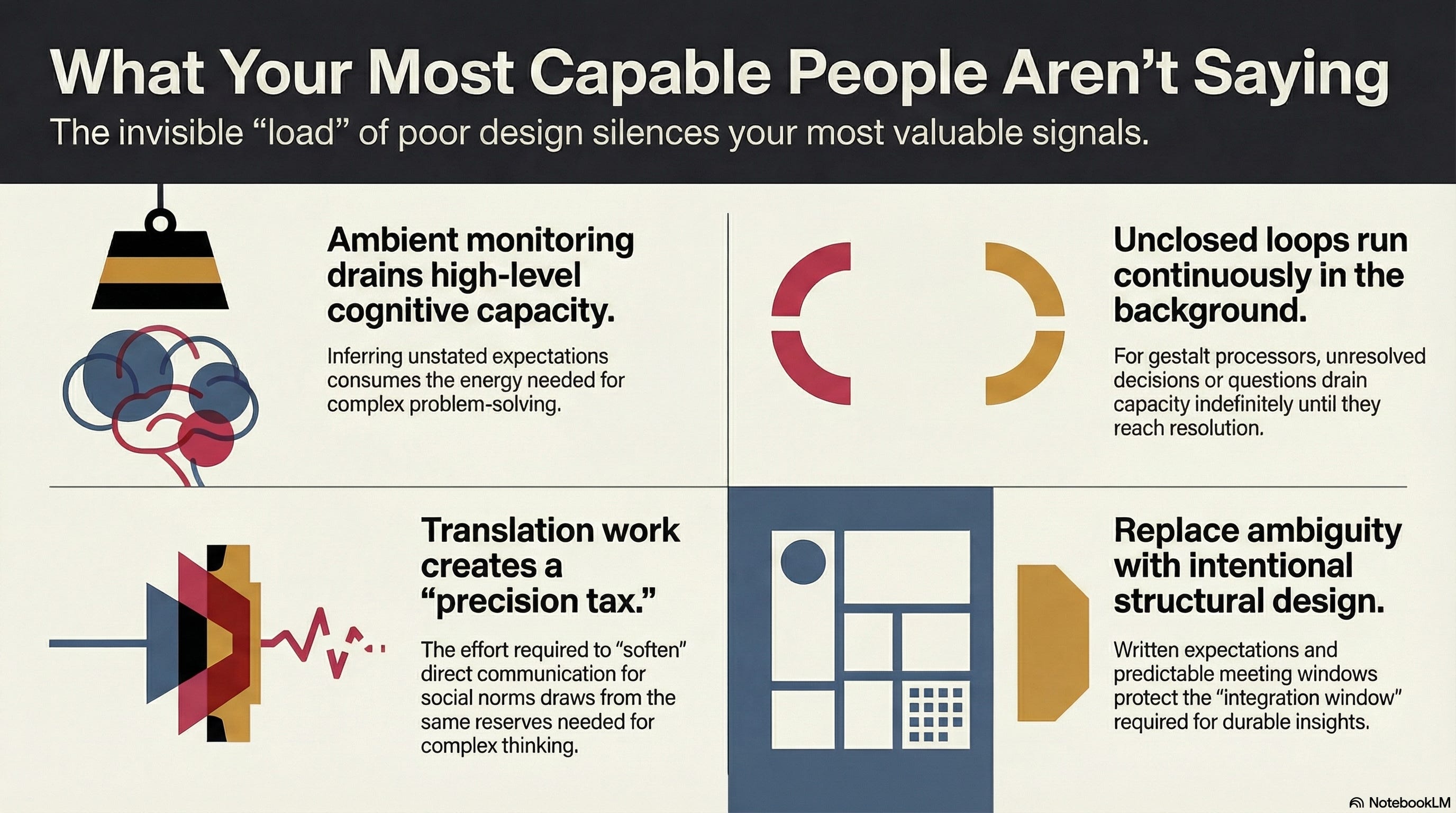
Infographic generated from source material using Google Notebook LM
The core argument
Some people are wired to see problems before they're visible, connect dots across systems, and identify emerging patterns from available signal faster than most people can articulate the question.
In healthy environments, this is an organizational superpower. In poorly designed ones, it becomes a burden the person carries alone until they can’t anymore.
This piece is about what happens to those people in remote and hybrid workplaces, why they go quiet, burn out, or leave without warning, and what leaders can do differently.
What’s actually happening
When expectations are ambiguous, people can’t protect their time or trust their read of the environment. For people whose thinking depends on having a stable, coherent picture of the whole, ambiguity isn’t just inconvenient. It breaks the architecture they work from.
When the official story and the real story don’t match, these professionals get stuck holding both simultaneously with nowhere to put what they know. For autistic people specifically, this isn’t just stressful. It is a loop the brain cannot stop running. It has no natural off-ramp.
Unresolved decisions and open questions don’t sit quietly in the background. They run continuously, draining capacity whether or not the workday has ended. Rest doesn’t close them. Only resolution does.
Softening communication, managing tone on video calls, editing precision into palatability: all of this is work. It draws from the same reserves needed for complex thinking. Environments that require it in only one direction eventually run those reserves dry.
Being put on the spot is only a problem when the picture isn’t complete yet. It’s not a permanent limitation. It’s a timing problem with a simple fix.
What better design actually looks like
Written expectations. Predictable meeting windows. Agendas in advance. Protected focus time. Clear and consistent organizational priorities. Decisions that get communicated when they’re made. Open questions that get answered or explicitly deferred.
None of this requires a formal program. It requires leaders who operate this way as a matter of course. Many already do. Their teams know the difference, and so do their results.
None of this should require anyone to disclose a diagnosis or explain how their brain works. When the design is right, the benefits are available to everyone.
Audio companion
This essay was also produced as an audio discussion. If you prefer to listen, you can access it here.
Audio companion generated from source material using Google Notebook LM
Research and further reading
The analysis in this piece is grounded in lived experience and pattern recognition, but it is not without research support. The following threads informed the thinking, particularly around predictive processing, gestalt communication, allostatic load, and autistic burnout. Readers who want to go deeper will find these a useful starting point.
Sinha P, Kjelgaard MM, Gandhi T.K., et al. Autism as a disorder of prediction. Proc Natl Acad Sci U S A. 2014;111(42):15220-15225. doi:10.1073/pnas.1416797111
Note: the deficit framing in this title reflects the diagnostic culture of its context. The predictive processing mechanism it describes is what matters here, not the pathologizing of difference.
Pellicano E, Burr D. When the world becomes ‘too real’: a Bayesian explanation of autistic perception. Trends Cogn Sci. 2012;16(10):504-510. doi:10.1016/j.tics.2012.08.009
Van de Cruys S, Evers K, Van der Hallen R, et al. Precise minds in uncertain worlds: predictive coding in autism. Psychol Rev. 2014;121(4):649-675. doi:10.1037/a0037665.
McEwen BS. Stress, adaptation, and disease. Allostasis and allostatic load. Ann N Y Acad Sci. 1998;840:33-44. doi:10.1111/j.1749-6632.1998.tb09546.x.
Cage E, Troxell-Whitman Z. Understanding the Reasons, Contexts and Costs of Camouflaging for Autistic Adults. J Autism Dev Disord. 2019;49(5):1899-1911. doi:10.1007/s10803-018-03878-x
Milton, Damian. (2012). On the ontological status of autism: The ‘double empathy problem’. Disability & Society - DISABIL SOC. 27. 1-5. 10.1080/09687599.2012.710008.
Note: Milton's double empathy problem reframes communication difficulty as a bidirectional mismatch rather than a deficit located in the autistic person, directly relevant to the translation load section of this piece.
Trujillo JP, Holler J. Interactionally Embedded Gestalt Principles of Multimodal Human Communication. Perspect Psychol Sci. 2023;18(5):1136-1159. doi:10.1177/17456916221141422
Raymaker DM, Teo AR, Steckler NA, et al. "Having All of Your Internal Resources Exhausted Beyond Measure and Being Left with No Clean-Up Crew": Defining Autistic Burnout. Autism Adulthood. 2020;2(2):132-143. doi:10.1089/aut.2019.0079
Hoerricks, J. (2026). The Script is Not the Silence: Autotheory of a GLP Mind in a Pathologized World. Neurodiversity, 4.
Bluma Zeigarnik, original research 1927. Widely cited in cognitive psychology literature on open tasks and working memory load.
Coming this Friday
The solutions piece maps each of these dynamics to specific organizational practices. If you recognized your organization in the full essay, that piece is for you.
If this piece resonated, I’d love to hear from you in the comments or by message.
Glossary
A note before you read: the terms below describe cognitive mechanisms, load patterns, and survival strategies. They are not a catalog of deficits. Autistic people are people, with the same rights, worth, and capacity for meaningful contribution as anyone else. These terms exist to name what is real so that it can be addressed, not to pathologize difference or locate the problem in the person. The problem, as this piece argues, is in the design, and in the thousands of choices made every day to leave harmful conditions unchanged.
Allostatic load — the cumulative physiological cost of sustained stress and adaptation. Coined by Bruce McEwen, the term describes what happens to the body and brain when they are required to maintain stability through prolonged or repeated strain. Unlike acute stress, which resolves and allows recovery, allostatic load accumulates over time and changes the architecture of the stress response itself. Relevant here because the cognitive and regulatory demands described in this piece do not simply exhaust available energy. When sustained long enough, they alter the baseline from which recovery is possible. Rest reduces exhaustion. It does not automatically reduce allostatic load.
Ambient monitoring — the low-level, continuous effort of inferring what’s expected when expectations haven’t been stated or consistently modeled. Common in under-structured environments. Exhausting not only because it never stops, but because the person inferring carries the full risk of getting it wrong with no authoritative source to check against.
Bottom-up processor — someone who builds understanding from individual inputs upward. Detail comes first, and the whole picture emerges from accumulation. Can often keep working while some things remain unresolved.
Double empathy — a reframing of communication difficulty between autistic and neurotypical people, proposed by Damian Milton in 2012. The traditional deficit model locates the problem in the autistic person, who is understood to lack social or empathic capacity. Milton’s double empathy problem argues instead that communication difficulty is bidirectional: autistic and neurotypical people have genuinely different ways of processing and expressing experience, and neither fully understands the other without effort. The burden of bridging that gap, however, falls almost entirely on autistic people in most professional and social contexts. This is the structural condition that makes translation load necessary in the first place.
Emotional suppression — the active effort of containing, modifying, or concealing emotional responses in order to meet professional or social expectations. A component of masking, but distinct enough to name separately because the mechanism is different. Where translation load is about converting communication style, emotional suppression is about managing internal states that the environment does not have space for. The cognitive load of sustained environmental strain generates emotional responses. Those responses then require suppression. The effort of suppression draws from the same finite reserves needed for complex thinking, creating a compounding drain that is rarely visible and rarely credited. When suppression capacity is exceeded, the accumulated pressure surfaces as a larger external expression than the immediate situation appears to warrant. Autistic people are frequently blamed or punished for that expression without recognition that the environment produced it incrementally over time. The outburst is visible. The accumulation that caused it is not.
Gestalt or top-down processor — someone who needs the whole picture before the details make sense. Meaning is built from context first, not from accumulating individual facts. The frame has to hold before anything inside it can integrate.
Not all gestalt processors are autistic, and not all autistic people are gestalt processors. The overlap is significant enough to be relevant here, but the two are not the same thing.
Integration window — the interval between taking in new information and being ready to respond to it. Not hesitation. The actual work of making sense of something before speaking.
Loop closure — the resolution of an open question, incomplete process, or pending decision. For gestalt processors, unresolved loops that intersect with their work don’t rest. They run. Even during sleep. Closing the right loops at the right time is a functional requirement, not a courtesy.
Masking — the cognitive and behavioral effort of suppressing, modifying, or translating one’s natural communication style, emotional responses, and ways of processing in order to meet neurotypical social expectations. Often described as “passing” or appearing neurotypical. Masking is not deception. It is the continuous work of making one’s thinking, behavior, and presence legible to environments not designed to receive them, undertaken primarily for survival: financial security, social belonging, professional standing, and safety. In this piece, translation load refers specifically to the communication dimension of masking, and emotional suppression is another distinct component. Both are worth naming separately because they draw from the same finite cognitive reserves through different mechanisms. Cognitive load itself generates emotional responses that then require suppression, compounding the drain in a specific and often invisible direction. Masking is the broader phenomenon of which both are part.
Neurodivergent — an umbrella term for people whose neurological development, functioning, and perception differ from what is considered typical. Includes autistic people, those with ADHD, dyslexia, dyspraxia, and others. The term is not a diagnosis. It is a framing that locates difference in neurological variation rather than deficit, and that recognizes neurodivergent people as a population with distinct cognitive profiles rather than broken versions of a neurotypical standard.
Prediction error — what happens when the brain’s model of reality doesn’t match what’s actually happening. The brain is wired to resolve this. When resolution is blocked or unavailable, the loop runs continuously.
Prediction error loop — the mechanism by which the brain attempts to resolve the gap between its model of reality and what is actually happening. Prediction error loops are normal and continuous. Under ordinary conditions, resolution closes them quickly. The problem arises when resolution is blocked or unavailable, leaving the loop open and running indefinitely. When multiple unresolved loops stack, they run simultaneously in the background, compounding the drain on cognitive capacity. For autistic people, stacked unresolvable loops are not a temporary inconvenience. They are a sustained physiological demand.
Signal integrity failure — when the official version of events and the real version are in active contradiction. Different from ordinary ambiguity. Creates a specific kind of cognitive trap for people who are accurate at reading both.
Translation load — the cognitive effort of converting direct, precise communication into a form that meets social expectations. Constant in environments that require cushioning. Draws from the same reserves as complex thinking.