


GIF created by Jen Benford, The Divergent Talent Alchemist
Collaborators’ Note
This essay is a work of fiction grounded in the collaborators’ lived realities. Lula is a composite character. She is not any one person, and the workplace she moves through is not any one company. Her arc is built from experiences we’ve lived, witnessed, and heard repeated across the neurocomplex (neurodivergent) community with enough consistency to form a recognizable pattern. The names belong to Jen’s pets. The organizational dynamics depicted are real — and they are a real problem.
Chris Stephens, CPA, writes primarily about the late-diagnosed neurocomplex experience at work, in parenting, and in life. Jen Benford helps neurodivergent and multipassionate people stop apologizing for their range and build a life — work, voice, identity — on their own terms.
Between us, we’ve seen this story from enough angles to know Lula is not an anomaly. She’s a pattern we’ve watched play out. And patterns can be changed.
If you recognize your organization on these pages, we hope you’ll sit with that discomfort long enough to act. If you recognize yourself in Lula, we wrote the last section for you.
Content note: This piece names workplace harm, retaliation, and gaslighting. Take care of yourself as you read.
What you’ll find in this piece
We shaped five composite scenes to trace how these patterns unfold — from the first quiet report to the quiet exit. Between the scenes, we’ve layered in the diagnostic frame: what the nervous system is doing when the workplace stops making sense, who gets to define reality, and what genuine change would actually take.
Scene 1 — The First Report. What happens when raising a concern becomes the concern.
Scene 2 — The Documentation. How diligence gets rebranded as pathology.
Scene 3 — The Product. When the concern is about the work itself, not the people.
Scene 4 — The Role Reassignment. How retaliation dresses itself up as opportunity.
Scene 5 — The Diagnosis. The moment the system says the quiet part out loud.
We close with what a system committed to actually not producing this outcome could look like — and a section for Lula, if you happen to be her.
A quick word on the word. Gaslighting is often used casually, but the American Psychological Association defines it more precisely: manipulation that leads someone to doubt their perceptions, experiences, or understanding of events. It’s a pattern, not an incident. That distinction matters here. Lula’s story isn’t about one conversation. It’s about what happens when the pattern becomes the environment.
Lula goes to work every day expecting one thing above everything else: to be safe.
Just safe. Safe enough to exist as herself without being mocked. Safe enough that if anyone crosses a line, someone with the power to do so will act. Safe enough that the people responsible for the environment she works in take that responsibility seriously.
That’s not a high bar. It’s the floor.
This is the story of what happened when the floor gave way. It’s also the story of what that floor is made of, who builds it, who gets to stand on it, and what it costs when organizations decide it isn’t worth maintaining.
Scene 1: The First Conversation with HR
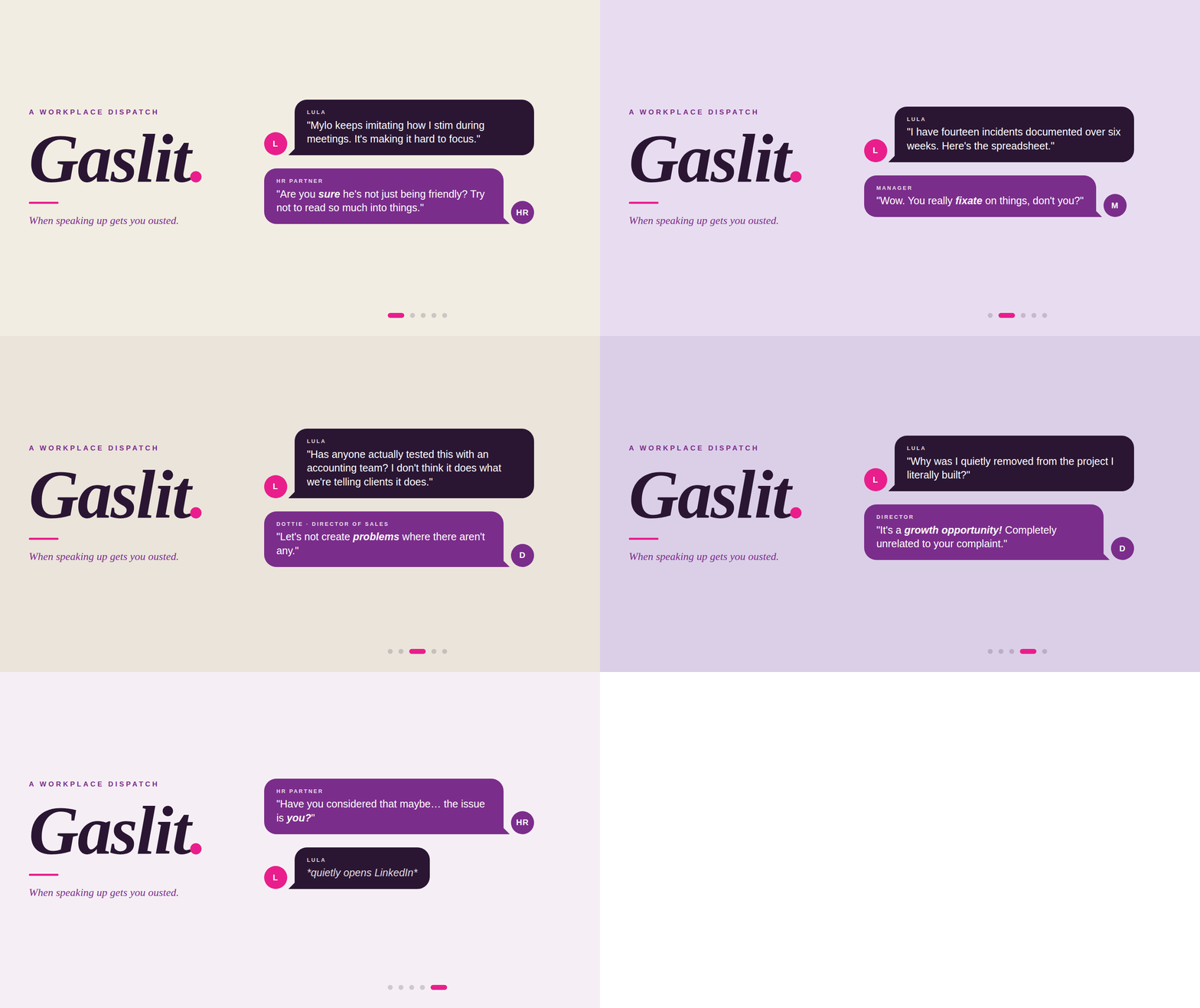
Lula: “Mylo keeps imitating how I stim during meetings. It’s making it hard to focus.”
HR Partner: “Are you sure he’s not just being friendly? Try not to read so much into things.”
Lula walked into an HR conversation; she wasn’t filing a formal complaint. She was asking her employer to do its job. She wanted Mylo to stop. She wanted someone to talk to him, make it clear that mocking how a colleague’s nervous system regulates itself isn’t acceptable, and ensure she could sit in a meeting and participate fully without bracing for what he might do next. She wanted to know her employer had her back.

According to Gallup, research shows that neurodiverse individuals offer unique abilities in creativity, innovation, and complex problem-solving — skills organizations often say they want. But Gallup also finds that 37% of employed neurodiverse individuals choose not to share their condition with coworkers, feeling that peers and leaders will stigmatize their natural ways of thinking, feeling, and behaving. Further, 46% don’t ask for accommodations during the application process, feeling it would be a disadvantage and might get them labeled “high maintenance,” “difficult,” or “needy.” And while 45% say they told their manager or supervisor about their neurodivergence, many still mask at work.
Deloitte’s recent global disability inclusion research adds another layer: even in workplaces that publicly welcome neurodivergent employees, only about 3–4% self-identify. Deloitte’s 2024 survey found that 41% of respondents with disabilities, chronic health conditions, or neurodivergence had experienced workplace discrimination — most commonly through microaggressions, bullying, or harassment.
Masking isn’t a preference. It’s a protective response. A 2023 study in PLOS ONE of 472 adults found that autistic, non-autistic neurodivergent, and neurotypical workers alike described workplace masking as an adaptive response to socially grounded workplace challenges — usually employed as a strategy to safeguard against negative social and employment outcomes. Which is a clinical way of saying: people hide because they’ve learned it’s not safe not to.
What Lula shouldn’t have had to consider was whether to suppress her stims — to hold her body still when it needs to move. Some might call it masking, but stimming isn’t a behavior to be managed or hidden. It’s how some nervous systems regulate themselves. Suppressing it doesn’t just cost Lula her social comfort. It costs her focus and can tip her into dysregulation at exactly the moments when she needs to be most present.
The fact that Mylo’s mockery may have forced Lula to choose between showing up without the effort of suppression and protecting herself from ridicule is its own injury, compounding with every meeting, every room, every moment when she has to calculate the cost of being visible. That calculation is exhausting, and it should not be Lula’s to carry.
Lula wanted sensitivity training, accountability, and the basic assurance that she deserved to come to work and be a whole human being. Each of those things was within the organization’s power to provide. None of them required an investigation, a formal process, or anything more than taking her seriously.
Instead, she was asked if she was sure.
That question did something specific. It didn’t merely fail to address Mylo’s behavior. It shifted the burden of proof to Lula, cast her perception as potentially unreliable, and signaled that the cost of raising this concern would fall on her — not on him, and not on the organization that employs them both. All in two sentences.
This is the ground level of psychological safety, and the employer failed to maintain it.
When psychological safety exists, the American Psychological Association describes it as an environment in which team members can take risks, admit and discuss mistakes, openly address problems and tough issues, seek help and feedback, and trust that they are a valued member of the team.
If you’re a workplace that says you care about psychological safety and true belonging, this is one of the uncomplicated routes HR could have recommended — and the company could have taken — while handling the situation with care.
Talking to Lula and understanding her needs is a simple step. Then talking to Mylo separately, with genuine curiosity rather than a predetermined conclusion. Too often, HR representatives skip the basic due diligence of hearing both sides — because HR is often undertrained and laser-focused on risk management instead of the actual human experience at work. Mylo’s behavior needs to stop, regardless of what this conversation uncovers. It may not be illegal to be a jerk at work but dismissing behaviors (especially repeatedly) that harm someone’s ability to function, focus, and feel safe isn’t just unfair. It’s a choice, and it has real consequences.
Why it happened is relevant to what comes next. If it came from thoughtlessness, that gets addressed differently than if it came from something else. As people and culture leaders, we have to look at intent where possible, instead of automatically backing the more senior person or walking into conversations with our minds already made up because of implicit biases about a person or a community.
Let’s just say it: 1 in 5 people are neurodivergent, making up around 20% of the population. And if Mylo is also neurocomplex, that introduces a layer worth understanding — not as an excuse, but as context that shapes how the conversation happens and what support might look like for all parties.
These situations are nuanced, and there are many different scenarios in the people relations space. Sometimes the person sharing the information with HR or their manager isn’t comfortable being in the same room with the person who is making them feel unsafe. A best practice is that bringing them into the same room happens only if both parties feel safe doing so, and only after both have spoken with HR or the designated managerial stakeholder separately. If the conversation reveals a gap in awareness that others on the team might share, that’s information worth acting on — through broader sensitivity training or resources that teach people with different brain and nervous system wiring how to work together well. But none of that replaces individual accountability, and none of it changes the fact that Lula’s experience was real and deserved to be taken seriously from the first sentence she spoke.
The harder truth is that a genuinely inclusive environment reduces the likelihood that this happens in the first place. Explicit policies, leadership that models the behavior it expects, and a culture where difference isn’t treated as something to manage or poke fun at — these are what make the floor solid before anyone has to report that it isn’t.
What the Nervous System Already Knows
Every person in a workplace reads their environment, whether they know it or not. Is what I’m seeing real? Does what I hear match what’s actually happening? Can I trust the feedback I get?
People don’t typically sit down and ask themselves these questions. They run beneath the surface, processed by the nervous system the same way it monitors the temperature of a room or the pitch in someone’s voice — automatically, and without permission. Staying oriented isn’t a choice. It’s a survival function.
Orientation as a survival function isn't learned. It's the baseline condition the nervous system is always trying to maintain. This is consistent across multiple research frameworks — Porges on neuroception, LeDoux on nonconscious threat detection, and Barrett on predictive processing — each arriving from different directions at the same core finding: the nervous system continuously and automatically scans the environment for cues of safety or threat, below the level of conscious awareness. The capacity is innate, not acquired. What shifts over time is what the nervous system learns to treat as a threat, and how we respond when orientation breaks down.
For Lula, that function had worked exactly as intended. She saw something real. She reported it through the “proper channels.” The problem wasn’t her perception. The problem was that the pathway designed to receive this kind of information responded by questioning her ability to perceive.
When an institution consistently dismisses valid concerns, it corrupts one of the nervous system’s most important functions: a reliable signal from the outside world. The employee’s careful observations — what they’ve seen, heard, and experienced firsthand — are treated as unreliable. Because the institution holds structural authority over what counts as true, its version tends to win regardless of accuracy. And the person who raised the concern walks away not only unheard, but less certain of their own ground.
And it’s almost as if the system is doing what it was designed to do. Is the system trying to gaslight the reporter into believing they are the problem? For having human emotions? For speaking up when someone or something makes them uncomfortable — probably exactly the way policy and canned trainings told them to?
Most people know it as dread. Or as exhaustion that arrives before the workday begins. Or as a specific form of hypervigilance that makes a calendar notification feel like a threat. It’s often a sign that the environment is broken, but if the environment can’t process that information, it gets routinely framed as the employee’s fault. Institutions that gaslight — whether by design or default — count on their employees to misinterpret the strain, to see it as personal failure rather than as evidence that something outside them has gone wrong.
Lula didn’t misread it. She documented it. And then she became “the problem.”
Scene 2: The Documentation
Lula: “I have fourteen incidents documented over six weeks. Here’s the document.”
Manager: “Wow. You really fixate on things, don’t you?”
Fourteen incidents. Six weeks. A spreadsheet.
In any organization that truly values the human experience, a situation like this should be taken seriously. This is exactly what someone is supposed to do when a concern goes unaddressed: document it. Create a record. Demonstrate that this isn’t a one-time misunderstanding but a pattern, with dates, details, and frequency. Lula did everything the way she was taught.
The response she received reframed her diligence as dysfunction. The same thoroughness that would have been praised in any other context became evidence of a “personality problem” — a workplace euphemism for someone who recognizes patterns and speaks up. In doing so, the organization discredited the documentation without engaging with a single line of it.
By the time Lula arrived with a spreadsheet, the organization had already failed her once by not taking her feedback seriously. The documentation existed because the first conversation had yielded nothing. That context is key. A manager receiving fourteen incidents over six weeks isn’t receiving a first report. They’re receiving evidence that a prior concern was dismissed, that the behavior persisted, and that Lula had to build her own case because the system did not take her concerns into consideration in this example.
The human response at this stage is harder than in Scene 1, because trust has already been damaged. But it isn’t impossible. The organization could still take the documentation seriously — reading it as the detailed, careful record it is, rather than as a symptom of the person who compiled it. And sadly, this story seems to be true for many people, who are positioned as liabilities to an organization instead of human beings with genuine concerns.
Reopen the conversation with Mylo, bringing the full weight of the record to bear. Acknowledge, at least internally, that the organization’s earlier response made this moment harder than it needed to be. But do organizations take accountability? Or do they shift blame to the person who is less senior on the invisible (or visible) org chart within the institution?
In an environment where inclusive behavior is modeled from the top and codified with teeth in policy, a manager receiving this documentation would feel the weight of institutional expectation to do the right thing. In an environment where it isn’t, the manager’s instinct is to protect the status quo. That instinct is what labeled Lula’s diligence as fixation rather than what it actually was: a record of her own real experience.
This is the move we often see. Use the person’s most reliable tool for establishing reality to show they can’t be trusted to handle it. It works because the institution has the authority to make that reframing stick, at least within its own walls. Linguists have been documenting this dynamic for decades. In critical discourse analysis — the field founded by Norman Fairclough — institutions don’t just describe reality; they possess the discursive authority to shape which version of events reads as common sense and which reads as fringe.
The result is a loss of orientation and identity. Lula can no longer fully trust her judgment. She begins questioning not only the specific incident but her overall ability to perceive accurately. Over time, the doubt stops being a response to what’s happening around her. It becomes the voice she hears first.
Underneath it all runs a current that rarely gets named: Lula needs this job. Not as an abstraction, but concretely. She needs the income, the benefits, the professional continuity. The organization knows this, even if no one says it out loud. That knowledge shapes every calculation she makes about how hard to push, how much to document, how loudly to object. It is no coincidence that the people with the least institutional power are often the ones with the least financial cushion to absorb the cost of standing up for themselves.
Psychological safety isn’t a value posted on a wall. It’s built or eroded in moments like this, consistently, over time. By this point, Lula had raised one concern through the proper channels and left the conversation without it being addressed. The organization has now had two opportunities to address Lula’s concerns. It has not acted on either one in this scenario.
To any organization reading this: this is a real problem. Whether deliberate or not, when you take someone who was functioning well, seeing clearly, and advocating for herself through the exact channels you told her to use, and you make her doubt herself — that’s not a neutral outcome. That’s harm.
For context, here is Lula:

Who Gets to Define Reality
Every workplace keeps some things visible and others private. Some employees are rewarded, others punished. Some voices carry weight, others don’t. Power shapes all of it, and it is never evenly distributed.
Power determines who defines reality. And the people in power almost always dictate the paper trail of what happens in the organization, regardless of the truth.
In a healthy system, reality is established through evidence, dialogue, and accountability that flow in every direction — not just downward. Feedback flows up, across, and back again. Everyone is accountable to everyone else. In a gaslighting system, reality belongs to whoever has the most authority to impose their interpretation. That authority rarely gets questioned — not because people don’t see the problem, but because they’ve already seen what happens to those who try to shed light on it.
These are often the same organizations with open-door policies and annual engagement surveys. The gap between what they say they want and what happens to the person who takes them at their word is where gaslighting thrives.
Scene 3: The Product
Lula: “Has anyone actually validated this with the users we’re pitching it to? Because I don’t think it does what we’re telling them it does.”
Director of Sales: “Let’s not create problems where there aren’t any.”
This is a different kind of concern. Lula isn’t reporting on how she was treated. She’s reporting what she can observe about the organization’s product — the one they’re actively selling as a primary revenue source. The product is being positioned for a market it wasn’t originally built for. Lula has looked at it closely enough to know there’s a mismatch between what’s being pitched and what the product actually does, and as far as she can tell, no one has stress-tested it with the audience they’re now selling to.
She raises it the same way she has raised everything else: through the proper channel, with the right person, in good faith.
The response doesn’t address the product gap. It reframes Lula’s valid concern as the problem. “Let’s not create problems where there aren’t any” isn’t an answer. It’s a signal: the concern is unwelcome, the person raising it is a liability, and momentum takes precedence over integrity.
This is also where the systemic pattern becomes undeniable. One incident may be dismissed. Two can be written off as coincidence. But when the institutional response to every concern Lula raises is a variation of “the problem is you,” that’s not a series of unfortunate misunderstandings. That’s a system whose primary function is to protect itself — one that sees Lula’s pattern recognition as a threat rather than a value add.
High-fidelity perception is too often punished in environments that require perceptual compliance to function. Some people notice more because their processing isn’t softened by the same social conditioning that renders incoherence invisible to others. They notice what doesn’t add up and name it without strategic delay, careful political framing, or the instinct to protect the room from discomfort. In a healthy organization, that is a value add. In a gaslighting one, it is a threat.
When someone clearly sees a contradiction and names it directly, they are perceived as disruptive, even when they are correct. Especially when they are correct — because the accuracy is the problem. A system that runs on managed perception cannot afford people who see through it.
This pattern draws primarily on our lived experiences and the many stories we’ve read across the neurodivergent community here on Substack. For supporting data, see Hartman et al. (2023), cited in Neurodiversity in the Workplace: An Agenda for Research and Action (Wiley, 2024), which found that neurodivergent employees are more likely than neurotypical employees to identify and report inefficient processes and dysfunctional practices in the workplace.
What “right” looks like here is simple: take the question seriously. Not as an attack on the product team or a threat to the sales pipeline, but as exactly what it is — a legitimate concern from someone who has carefully reviewed the product and is doing her job. Investigate the claim. Test the use case. If the fit isn’t there, it’s better to know before customers do, so the organization can reshape the messaging. That’s not creating a problem. That’s preventing one. Everyone makes mistakes or has oversights as part of the human condition. But integrity lives in what you decide to do next.
Scene 4: The Role Reassignment
Lula: “Why was I quietly removed from the project I literally built?”
Director: “It’s a growth opportunity! Completely unrelated to your complaint.”
The U.S. Department of Labor defines retaliation as what happens when an employer fires an employee or takes any other type of adverse action against them for engaging in protected activity. An adverse action is one that “would dissuade a reasonable employee from raising a concern about a possible violation.”
Retaliation is not a fringe concern. Retaliation charges have been the most frequently filed category with the EEOC for seventeen consecutive years. In fiscal year 2024, retaliation accounted for 42,301 charges — roughly 48% of all discrimination charges filed. The reason it dominates is structural: retaliation can attach to any underlying complaint. Once someone raises a concern, whatever happens next is under a different kind of scrutiny.
And yet, retaliation rarely reveals itself as retaliation. It presents itself as an opportunity, a restructuring, a role clarification — or, in Lula’s case, growth. But the person on the receiving end knows exactly what it is. The institution maintains plausible deniability, and the gap between these two realities is yet another thing Lula is expected to carry in silence.
By Scene 4, the organization has built a story about Lula. Not from her work, which, by every indication, has been substantial. But from the discomfort she caused by naming what was true. This story is now doing its own work on her personal brand and her sense of worth. The reassignment in this scenario isn’t just an example of retaliation, though it seems that way on the surface. It’s also the organization acting on a narrative it constructed about her — one that has almost nothing to do with her performance and everything to do with how much it has cost them to be clearly seen.
What’s often true of people like Lula is that they’re praised for their work right up until they say something uncomfortable. The quality of the contribution remains the same. The system’s comfort level changes, and once it shifts, the narrative follows. The same focus that made Lula valuable becomes fixation. The same directness that made her effective becomes aggression. The same pattern recognition that first identified the problem becomes the reason she can’t be trusted. The label the organization applies says more about what the system can tolerate than about the person wearing it.
This is what the costs look like when they accumulate.
When someone is required to maintain orientation in an organization that’s actively undermining it, they expend enormous energy on constant recalibration. Every meeting becomes a decoding problem. Every piece of feedback must be evaluated for distortion. Every interaction with institutional authority requires defensive processing that has nothing to do with the actual work and everything to do with survival. This load doesn’t appear in any performance review. It doesn’t appear in any organizational budget. But it’s real, and it’s cumulative.
The person carrying it has less capacity for the work they were hired to do, for the relationships that sustain them, and, over time, for the focus and self-assurance that made them effective in the first place. The organization extracts this capacity while simultaneously penalizing Lula for running low.
The right thing to do here is to be honest, even when it’s uncomfortable. If this reassignment was based on Lula’s complaints, say so and address it directly. If there were legitimate performance or behavioral concerns, name them specifically and give her the opportunity to respond to actual input rather than a managed narrative. If the project genuinely was a growth opportunity, explain how and why in terms that withstand scrutiny. Lula isn’t asking much. She’s asking for a straight answer. The organization’s inability to give her one tells her everything she needs to know — and she already knew it.
To the organization reading this: Lula built something you benefited from. You removed her from it, handed it to someone else, and told her it was in her best interest. You didn’t just take the project. You took her contribution, reassigned it, and made her responsible for accepting the reassignment gracefully. That’s not a growth opportunity. That’s a message. And she received it.
Scene 5: The Diagnosis
HR Partner: “Have you considered that maybe... the issue is you?”
Lula: *quietly opens LinkedIn*
By the time HR asks Lula whether she’s considered that the issue might be her, the organization has already answered its own question. Every scene has been a variation on the same verdict. This is just the first time they’ve said it outright.

This is where many people’s stories end. Not with a confrontation. Not with a formal complaint, a legal filing, or a dramatic exit. With a quiet decision, made alone, that the cost of staying has finally exceeded the cost of leaving.
The organization will likely never record this failure as a failure. There will be no line item for what Lula knew, what she built, what she tried to protect, or the cost of walking away. The system will remain intact, having successfully routed around the person who saw it most clearly. And six months later, someone else will sit in Lula’s chair and notice that something seems a bit off.
Most people don’t test the same wall twice. They get the message. The next time something feels wrong, they hesitate. They weigh the cost of speaking up against the cost of staying quiet, and they choose silence — not because they stopped seeing clearly, but because they learned what happens when they say it out loud. The organization never has to silence them again. They’ve learned to do it themselves.
This is the most efficient outcome a gaslighting system can produce: employees who self-censor, absorb the dysfunction without naming it, and perform well on paper while slowly losing sight of why they came here in the first place.
What the organization will do next is tell itself a story. That Lula wasn’t the right fit. That she was hard. That they tried. They’ll post the role, interview candidates, and put another person in the chair. Maybe they’ll split her role up and hand it off to multiple people, since she was doing the job of more than one person. If the environment that produced this result remains intact, the next Lula will arrive full of capacity and good faith, and the cycle will begin again.
There is no “what right looks like” in Scene 5. That window closed in Scene 1. What remains is a choice about whether the organization is willing to go back to the beginning — not to fix what happened to Lula, but to build something that doesn’t produce this outcome. The culture, the policies, the modeling, the oversight structures. Not canned sensitivity training. Not an engagement survey. The whole thing from the ground up. A system that truly values the people who show up every day to keep the wheels on the bus.
What often goes unacknowledged is how difficult it can be to leave, even when staying is clearly the wrong choice. Some organizations, consciously or not, make the exit as difficult as the environment itself. They pull people back with promises, sudden recognition, and the suggestion that things are about to change. Even when the person knows it’s time to go, it can feel like a real possibility. It isn’t. It’s the system protecting its own continuity.
Lula sees right through it. She closes the tab she’s been living in for months. She opens a new one.
What It Would Actually Take to Change
Lula’s story doesn’t have to keep repeating itself. But preventing it takes more than good intentions.
Individual resilience is not a long-term solution. The problem isn’t that Lula or anyone like her lacks sufficient coping mechanisms. The problem is that she operated in an environment specifically designed to deny her experience and protect those who created it.
Change requires structural accountability — systems where the person who raises a concern isn’t automatically required to prove it without support, where the institutional response to documented harm doesn’t default to protecting the hierarchy, and where the burden of dysfunction is distributed proportionally rather than concentrated on whoever has the least power to refuse it.
It requires signal integrity. A genuine organizational commitment to honest feedback over a managed narrative. That means creating conditions in which bad news can travel upward without being intercepted, reframed, or punished. It also means trusting that the person closest to a problem often has the most accurate read of it — even if they are junior, different, or their delivery is imperfect.
It requires reciprocity. When one person is perpetually required to carry the unseen burden of a system’s dysfunction while others are protected from the consequences of creating it, that relationship is extractive. Extraction isn’t sustainable or just.
And it demands that organizations reckon with the gap between what they say they value and what they actually do when they have the opportunity to take someone at their word. If you read Lula’s story and recognize your organization, that recognition is the beginning of something. We do not have all the answers and every workplace is different, but this is a start.
For Lula
If you’ve lived through this, you were not wrong. What you saw was real. What you felt was real. The alarm that kept going off wasn’t a malfunction. It was your nervous system doing exactly what it’s supposed to do in an environment that was as broken as you knew it was.
The fact that you couldn’t prove it at the time doesn’t mean it didn’t happen. The fact that the system closed ranks doesn’t mean your perception was wrong. The fact that it cost you something real doesn’t mean you should have stayed silent.
And if you’re still inside it, weighing whether to stay or go, know this: the job market is precarious, and these dynamics are rarely visible from the outside during an interview. You’re not naive for not seeing it coming. These environments are designed to look functional until you’re already in them. The decision of when and how to leave is yours alone. There is no wrong answer to an impossible question.
What was asked of you was unreasonable. What happened to you had a name. The clarity you’re rebuilding now, on the other side of it, is not small.
And here’s what your clarity actually is: not a wound. Not a liability. Not something to unlearn. The same pattern recognition that made you a threat in a broken system is exactly what will help you find — or build — one that isn’t. That doesn’t happen in a straight line. But you’re not starting over. You’re starting from here, with everything you now know.
There are workplaces, collaborators, clients, and communities where what you see clearly will be received as what it is: a gift, not a threat. They exist. Some of them are already looking for you. And when you find them — or build them — you’ll know exactly what to look for, and exactly what to walk away from.
Lula deserved better. And so do you. And what you now carry is worth more than any workplace that couldn’t hold it.
About Jen
Jen Benford helps neurodivergent and multipassionate people stop apologizing for their range and build a life — work, voice, identity — on their own terms. She writes The Divergent Talent Alchemist on Substack, where she moves between neurodivergent identity, creative reinvention, career shape-shifting, and coming home to yourself when the systems you grew up in weren’t built for you. Subscribe at

Jen also offers 1:1 coaching for neurodivergent and multipassionate people working through identity, work, and the shape of a life that fits them. She recently launched The Divergent Brand Cohort — a group container for people building a body of work on their own terms — with future cohorts opening for the same. Reach out at hello@benfordtalentalchemy.com if you’d like to talk.
If this piece resonated, be sure to subscribe to The Divergent Talent Alchemist and start with the following pieces:
We’re also hosting a live session on The Divergent Talent Alchemist on Gaslighting in the Workplace on Wednesday, July 22 at 7:00 AM (PT) / 8:00 AM (MT) / 9:00 AM (CT) / 10:00 AM (ET) / 3:00 PM (BST). Click here to join.
 | A guest post by
|
One of my favorite pieces to work on 💜 thank you for for sharing your wisdom
Well! A wheelbarrow full of truth! It's validating to read your assessment, my friends. I would have loved to have had this kind of feedback for the last 50 years, but didn't. I'm so glad you're providing it now. Help the younger ones stay off the medications they gave me to "iron out the anxiety."